
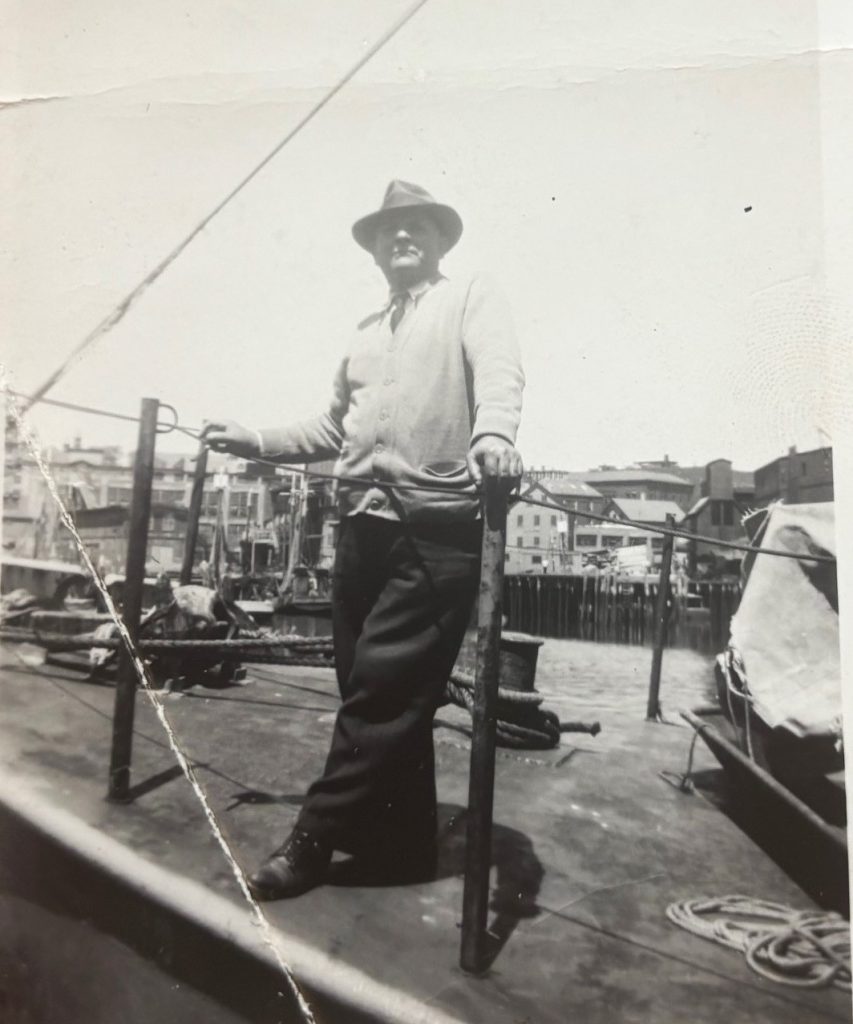
In January 1942, the Gloucester Daily Times announced sweeping new restrictions on so-called “enemy aliens.” Italian, German, and Japanese-born residents were ordered to register with federal authorities. For Gloucester’s Sicilian fishing community, including my grandfathers, the news was devastating. The harbor that had once sustained their families suddenly became forbidden ground.
Fishing in Gloucester was never simply an occupation: it was survival, identity, and belonging. My grandfathers, Pietro Favazza and Filippo Millefoglie, arrived as teenagers from Terrasini, Sicily, during the great wave of southern Italian immigration in the early twentieth century. Like thousands of others, they came seeking belonging and work in the nation’s oldest seaport. They built lives at sea, hauling nets in dangerous waters, and sending wages home to relatives across the Atlantic. Yet after the attack on Pearl Harbor, they were branded potential threats to the nation they had helped sustain.
The legal authority behind these wartime measures was the Alien Enemies Act of 1798, invoked by President Franklin D. Roosevelt in the aftermath of the Japanese attack on Pearl Harbor on December 7, 1941. Through a series of presidential proclamations, foreign-born nationals of Axis powers — first Japanese, then Germans and Italians — were classified as “enemy aliens.”
The consequences were most severe and enduring for Japanese Americans. More than 120,000 people of Japanese ancestry were forcibly removed from their homes in western states and incarcerated in remote internment camps. Two-thirds were U.S. citizens. Historians regard this mass detention as one of the most profound violations of civil liberties in American history.
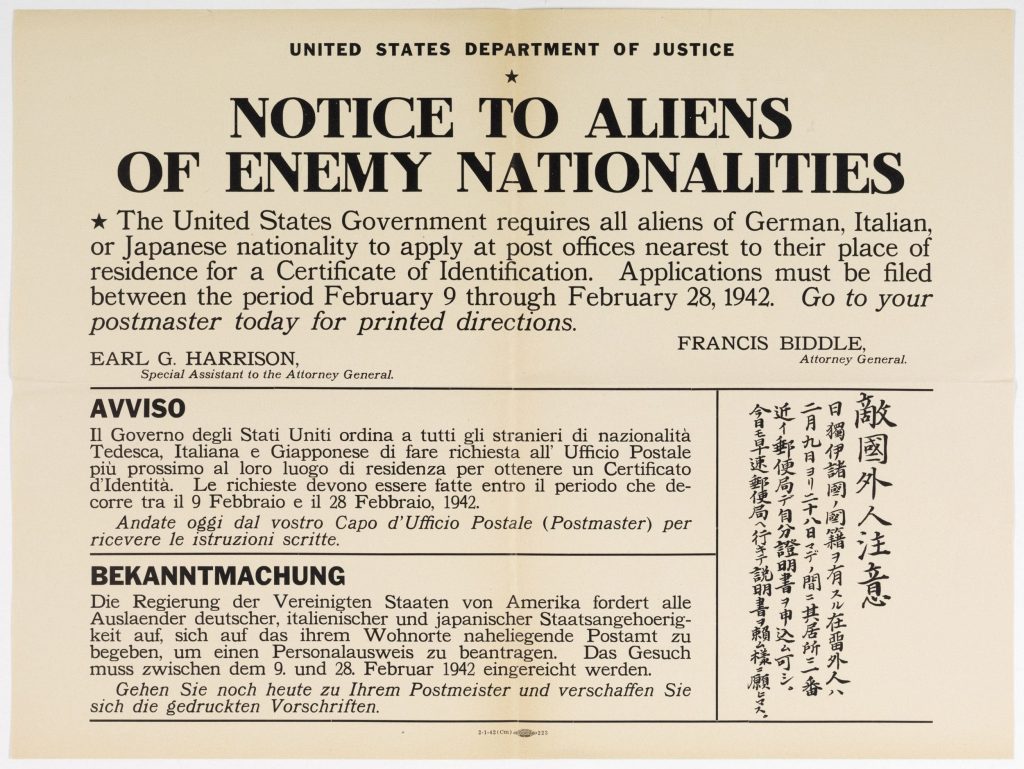
Less widely known is how the same wartime authority reshaped the lives of Italian and German immigrants who had not yet naturalized. Under Proclamations 2527, an estimated 600,000 Italian nationals were classified as enemy aliens; forced to carry identification cards, observe curfews, and surrender personal property such as shortwave radios, cameras, and flashlights. Travel was tightly controlled, and employment in sensitive coastal or industrial zones was prohibited. Thousands were relocated from their homes on the west coast to inland areas, and approximately three thousand were detained in internment facilities across the country.
In East Coast communities like Gloucester, restrictions struck at the core of daily life. Fishing vessels were idled or seized for military conversion. Non-citizen fishermen were barred from the waterfront entirely. More than 200 fishermen from Boston and Gloucester were grounded overnight, their livelihoods erased by proclamation. Meanwhile, these same families had sons serving in the US armed forces. From Gloucester alone, nearly three hundred Sicilian and Italian Americans enlisted, valued for their maritime skill and knowledge of coastal waters. The contradiction was painful.
Across the Atlantic, relatives in Sicily endured wartime scarcity and fear. Communication ceased. Money that had once sustained extended families disappeared. My grandmother Ninfa and her three sons crowded into my great-grandparents’ home in Terrasini, joining relatives until ten people shared a single household. Family stories recall selling jewelry, furniture, even mattresses simply to survive. War fractured lives across oceans, leaving families suspended between fear and uncertainty.
Citizenship proved elusive. Many Italian immigrants struggled with naturalization because of language barriers, limited education, and bureaucratic confusion. Wartime suspicion compounded those challenges. My grandfather Pietro finally received his certificate of naturalization in November 1943. My grandfather Filippo’s petition, however, was denied, a decision that altered the course of his life.
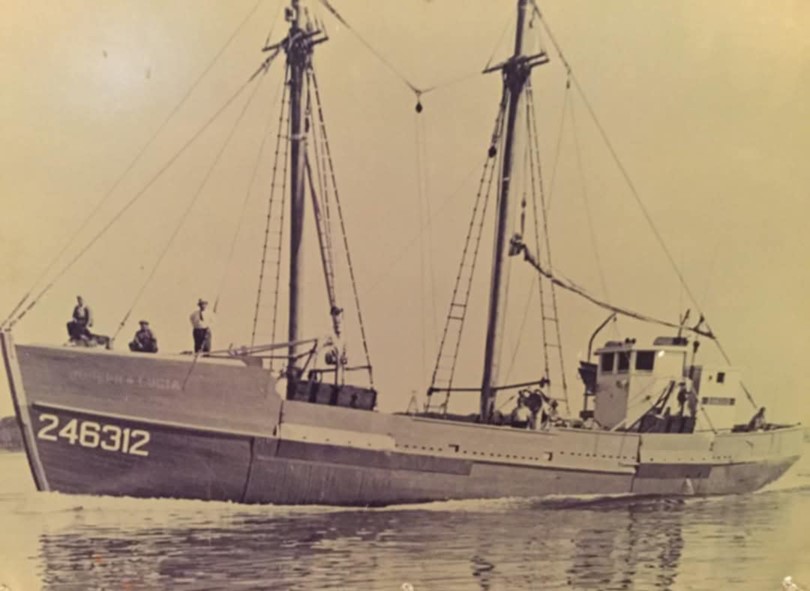
Unable to fish and uncertain about his future, Filippo left Gloucester and traveled more than three thousand miles west to California. Census records later confirmed his presence in waterfront neighborhoods in San Diego, San Pedro, and San Francisco, where he boarded with fellow Sicilians and pieced together work as he could. War and policy had set him adrift — from his livelihood, his home, and his family.
Restrictions on Italian enemy aliens were formally lifted in October 1942. Yet the consequences lingered long after the proclamations faded. It would be years before many detained immigrants were released, and longer still before families separated by war could rebuild their lives.
For my family, more than fourteen years passed before reunion became possible. After the war ended, my grandmother Ninfa and her sons finally sailed to America in 1946. Their arrival in Gloucester marked not only the end of separation, but the beginning of economic and emotional reconstruction. The men returned to fishing, while the women anchored families through faith, labor, and cultural traditions.
In 2025 the Alien Enemies Act resurfaced in political debate as a tool to address modern immigration concerns and national security threats. On January 20, 2025, President Donald Trump invoked the Act on the day of his inauguration, directing federal and state authorities “to use the full and immense power of federal and state law enforcement to eliminate the presence of all foreign gangs and criminal networks bringing devastating crime to U.S. soil.” Though framed as a measure of public safety, the action revived a statute designed explicitly for wartime conditions and recast it as a tool to shape immigration policy.
Deportations, expanded detention facilities, and new travel restrictions have revived questions about due process, executive authority, and the targeting of non-citizens by nationality. As of March 2026, the Trump administration reported deporting more than 600,000 illegal aliens, with an additional 1.9 million self-deporting out of fear and pressure.
Gloucester’s experience offers a cautionary lesson. During the war, Sicilian immigrants worked in one of the nation’s most dangerous industries, surrendered their boats for military use, and sent their children to fight abroad – all while enduring surveillance, exclusion, and confinement at home. Their loyalty was measured not by their labor or sacrifice, but by their citizenship status.
Today, new immigrants stand where my grandfathers once stood — waiting for hearings, certificates, or permission simply to work and support their families. The names and nationalities may change, but the underlying questions remain. How quickly can fear redraw the boundaries of democracy? How easily can neighbors be redefined as enemies? Remembering their story is not an act of nostalgia; it is a reckoning with the human cost of policy. Their experience stands as both testament and warning: a reminder that the language of security can reshape lives, and that the boundaries of belonging are often drawn in moments of fear.
–Maria Millefoglie
Maria “Mia” Millefoglie is the author of Daughters of Stone and Tide: Loss and Resilience in a Fisherman’s Family (forthcoming from University of Massachusetts Press). A writer and founder of WritePages LLC, she is now working with partners Sal Zerilli and Laura Ventimiglia at Cape Anncestry to produce a documentary on the lives of Sicilian and Italian immigrants in Gloucester during World War II.
